Folktales on the Fly
10 Random Folktales
"You Only Eat If You Work"
Updated on Monday, October 25, 2010 10:25:44 am
Told to I. Parharides
There was once a woman who had a daughter. Her daughter was very beautiful, but she was also very lazy, and anyone who wanted to marry her got word that she was that sort of person and decided not to have her. One day a young man came from abroad, saw the girl, and asked for her hand. The girl’s mother said, “My girl is not one for marrying. She is very lazy and I don’t want to make bad blood between us.”
He still said, “Even if she is lazy, I will marry her. I will make a hard worker out of her.”
Her mother said, “Eh, all right. But in the end you will find that I was right.”
So they held the wedding and the man crowned her and took her back to his land. As they were going along, they didn’t let the bride have anything to eat. When she arrived at his house, he told everyone there not to give her anything to eat and to tell her, “Here you only eat if you work,” if she asked, “Why don’t they give me anything to eat?”
The bride fasted for one day, she fasted for two, then she complained that everyone else was eating but they weren’t giving her anything to eat or calling her to the table. After a good while she dared to ask a girl there, “Why aren’t they letting me have anything to eat?”
She said, “Didn’t you know? Here you only eat if you work.”
“Really? If I work, they will also give me something to eat?”
“Of course they will.”
The next day she arose very early and did the sweeping, washed the dishes, did all the other chores, and then picked up a distaff and sat down to spin! That day they called her to the table, and she was so overjoyed she didn’t know what to do. She had become a hard worker. She always did the chores, they always called her to the table, and she was able to eat.
One day the bride’s mother arrived to visit her daughter. When she went into the house, the bride was grinding garlic. When she caught sight of her mother, she ran to give her the mortar saying, “Do some grinding! Otherwise they will not feed you: here you only eat if you work.” Her mother laughed, took the mortar from her, and did some grinding.
"The Three Princes"
Updated on Monday, October 25, 2010 10:12:39 am
Told to I. G. Valavanis
There was a king who had three sons and three daughters. One day the king was bothered in his mind and said, "Anyone who comes and asks for my daughters must have them."
One day the king of the bears came and asked for the king’s daughter. The king could not go back on his word, so he gave his eldest daughter to the bear. Afterward the king of the wolves came and married the second daughter. Last the king of the birds came and took the last daughter. Then the king's three sons-in-law left.
When the king had grown old and was about to die, he said to his sons, "You may go hunting on every mountain, but you may not hunt on that mountain over there."
When their father had died, his sons went to all the mountains, but didn’t find anything to shoot. They among themselves, "We should go to that mountain where our father forbade us to go."
To this they all agreed and they went off. When they came to the mountain they saw a large palace, three stories high, very big with its doors open wide and small windows. They went in and found tables laid and all sorts of food. They sat down and ate and drank until the evening.
In the evening when they were going to go to sleep, the eldest one said, "I will keep watch tonight, lest someone come to attack us."
So the eldest brother kept watch while the others were sleeping. At midnight he heard a rustling, and what did he see? The whole mountain was moving and trembling, and when he could see well, he saw a huge serpent with one head entering the palace. He immediately took his sword in his hand and fought the serpent and cut off its head, and the blood ran out like a river. He killed the serpent and threw it down into a gully, then took some water and washed away the blood. At dawn his brothers arose and asked, "Did anything come in here?"
He said, "Nothing came in, nor did I see anything."
The next evening the second brother kept watch. A serpent with two heads came along and, as I’ve already told you, he killed it with his sword and then took some water and washed away all the blood. When his brothers arose in the morning he told them the same thing his elder brother had said.
The next evening the youngest brother kept watch. His brothers did not want him to, but he stood up to them saying, "I will keep watch," and he did. But what did he see? A huge serpent with three heads wanted to enter the palace, but he immediately seized his sword and began fighting it. The serpent struck the boy down once or twice, but he fought back and struck at the serpent, but the serpent was just about to defeat him. Then the prince gave it a little room, then took a firm stance, drew his sword, slashed at it again and again. The serpent started lashing its tail and the prince smote him to the ground. The boy fought madly but cunningly, and every time the serpent rose up he ran back. The serpent then hit out right and left and ended up putting the light out with his tail. The prince couldn’t get it to light again. He considered how to go about getting a light. He saw a light burning a very long way off and he started to go to it to get a light so that he could kill the serpent and wash away the blood.
On his way to the light he caught sight of an old man who had two balls of thread, one white and one black. The man was winding up the black thread, which was nearly at an end and about to give way to the white. When he came near, he said, "Good evening, grandfather."
"Good evening. Where are you going at night, my good boy?"
"I am just taking a walk in this good weather. What are you doing here?"
The man said, "Well, as you see, my dear, I am bringing the night to an end and bringing a start to the day. You know that many men in trouble long for the day."
"No, grandfather, don't finish winding up the black ball. Don’t bring about the start of the day before I return from going to that fire."
The man said, "Oh no, my good boy! I can’t do that: the whole world is troubled and now expecting the day."
Then the boy became angry and he tugged the black ball away, though he let the old man have the end of it to hold saying, "Don't wind it up until I come back."
But the old man refused, which made the boy grow still more angry. He threw the old man down and set a heavy stone on him so that he could not get up.
When he got to the fire, he saw an old woman sitting there and a big cauldron boiling on the fire; it had forty handles. "Good day, good mother," said he.
"Good day to you," said the old woman. "If you had not called me ‘good mother,’ I would have eaten you up."
The prince said, "If you had not said ‘good day’ to me, I would certainly have eaten you up."
"What do you want?" said the old woman.
"Fire," said he.
"Anyone who wants to have fire from here must lift this cauldron and move it." (The cauldron was always lifted by her forty sons, who were ogres.) "Lift up the cauldron," she said, "and move it."
So the boy lifted up the cauldron and set it down again in its place. Then he took a light from the fire, set the cauldron back on the fire, and prepared to leave. Then the old woman spoke again, "Come and sit down here a little, my good boy. I have something to say to you.”
As he was turning back to her, her forty sons, the ogres, returned. They caught sight of the boy and wanted to eat him. But their mother said to them in a whisper, "Hush, hush! he can master you all. Why, all by himself he lifted the cauldron and took fire from beneath it. He was just going away again when I called to him. He will eat you all up: hush, hush!"
So the ogres said, "Good evening, brother."
The boy said, "Good evening to you."
They said, "Will you become our brother?"
"I will, and why not?"
So they sat down and ate and drank together.
Now the forty ogres were at war with a king. They now wanted to take the prince to the war with them. The ogres had fought and fought, but they hadn’t been able to defeat the king, because his palace was built on all four sides like a strong castle. So the ogres said, "Will you come with us to the war?"
"Against whom are you fighting?' he asked.
"With the son of the Rose of Delight, a very powerful king."
He said, "I will, but first you must take a long chain with you."
So the ogres took a chain and set out and came to the palace. The prince said: "Drag the chain to the castle and make it fast to the castle wall."
They all pulled at the chain, but none of them could make it fast to the wall. So the boy took the chain and pulled it up and attached it to the wall. Then he said, "You stay here while I climb up, and then you can each come up one by one."
He climbed up and cried out, "Now one of you climb up."
So one of them climbed up and the boy said: "Come on, I will let you down the other side." But the boy took the ogre, cut off his head, and threw him down a well. Then he cried out, "Another one of you climb up, because I have let the first one down."
Then another ogre climbed up the wall, and him, too, the boy killed. When he had killed this next one he threw him where he had thrown the other, and thus he killed and got rid of them all.
Then by pulling the chain over to the other side of the wall, he climbed down into the palace courtyard. When he had gotten down, he entered the palace. When he opened the door of the first room and what did he see? The king and the queen asleep in the room. The king's wife had just had a boy baby, who was lying in his cradle. Every year the king had had a baby and a serpent kept coming and eating the child. Soon as the boy was looking here and there, what did the he see? There came a great serpent, a great big one I tell you, that was on its way to devour the baby. The boy immediately drew his sword and killed the serpent. Then he saw the king's sword hanging on the wall. He took the king's sword and hung up his own up in its place. Then he went out of that room and saw the king's eldest daughter where she was lying asleep. He took his eldest brother's ring off his finger and put it on her finger, and the girl's ring he put on his own finger; thus he betrothed her. Each of these three brothers had a ring; he was wearing his own ring and the rings of his two brothers. Then he went on to the next room, where he saw the middle sister sleeping. He took her ring also, and put on her finger the ring of his second brother. Then he went to the next room, and there he found the youngest daughter sleeping. He took her ring and put it on his own finger, and in this way he made betrothals for himself and for his brothers. The king had only those three daughters and no other children, because the serpent had devoured them. Now he had also the baby boy whom the boy had saved from the serpent’s maw.
The prince then turned back. He went back to the old woman and took some fire from her and then he went back to the old man and took the stone off him saying, "Now I am going back to my house so you can pull the white ball of yarn forward."
Then he ran off and went back to his house, lit the fire, and used water to wash away all the blood from where he had killed the serpent. In the morning his brothers rose and questioned him, but he said, "Nothing came here, nor have I seen anything."
Now the story leaves them all there.
In the other land the king arose, and what did he see? The serpent lying dead and the baby alive. Then his eldest daughter came to him and said, "Father, look! My ring has been changed. What have you done that made me lose mine?”
His second daughter and his third came and said the same thing. The king began pondering, "Some fine young man has been here in my palace."
To find out who it was, he sent a message around the whole country saying that everyone must come to tell him a story, anything they knew. They all came and no one failed to bring him a story, whatever he chose. Then the king asked, "Is there anyone who hasn’t come yet?"
His servants said, "In a certain place there are three youths who haven’t come yet."
So the king summoned them. The first one, the eldest, came and told how he had killed the serpent with one head. The second came and told how he had killed the serpent with two heads. Then came the youngest, who told everything that had happened to him. The king was amazed, saying, "So my girls belong to you. Take them and go with God's grace."
Then the youth took his three girls out into the courtyard. He gave the two elder ones to his brothers and took the youngest for himself. So they went off.
As they were on their way, a giant bird came down and seized the youth’s wife in his talons and flew off with her. The boy wept and cried and shouted, but this did no good at all. His wife was gone. His brothers began giving him consolation and advice, but it was no use. With him still weeping and lamenting, they took him in the evening back to their palace.
In the morning he arose and said to his brothers, "I must go and look for her."
So he went off to his brother-in-law the bear and, when he had told him the whole story, he asked him what he should do and whether he knew where the giant bird could be found. The bear said, "How should I know? The bird is nowhere to be seen, so how can I say where it is? I will carry you away out of my domain and across my borders and bring to the borderline of the wolf, so that no bear will eat you. Then you should ask the wolf: perhaps he knows."
So the bear took him to the wolf and the wolf repeated to him just what the bear had said. Then he carried him to his brother-in-law the bird. Then the youth made his lament to the bird, and the bird said, "Your business is very difficult. It is impossible for you to rescue her from the talons of that giant bird, and if you go there the bird will eat you up."
But the boy would not accept this. He said, "Where is this giant bird? What region is he in?"
Then his brother-in-law the bird showed him where the giant bird was, gave him a horse, and said, "When you go there you must say to your wife, 'If the giant bird comes and eats me, you must tie my bones onto the back of my horse and give him a lash and tell him to go back to the place from which he came.'"
Then the youth went off and came to the house of the giant bird. He went in: the bird was then out hunting, and the boy said to his wife, "When does the bird go out hunting?"
She told him and he said, "If he comes and eats me up, you must tie my bones onto the horse, give him a lash, and tell him to go back to the place from which he came."
Before the girl had time to say "He is coming," the giant bird entered the house. When he saw the boy--gobble, gobble--he ate him right up. The girl wept and lamented to herself and, without being seen, gathered up all the bones, set them on the horse, gave it a lash, and said, "Go back to the place from which you came."
The horse went to the house of his sister, the wife of the king of the birds. When his sister saw him, she lamented and cried out. Then she took the bones, set them in order, and then by her magic art poured a drug over the joints and brought them back to life. In ten days he became well again and once more wanted to go on his way. But his sister said, "Do not go back! If you do, I won’t be able to bring you back to health again."
But he wouldn’t listen to her: he started on his way, and went on and on and on until he came to the house of the giant bird. He went in and said to his wife, "Ask the bird where his strength lies."
Then he went out. Knowing at what time the bird went out hunting, it was easy for him to come to the house. Next day he went there again and his wife said, "He has told me that he has his strength in the broom."
He said to her, "This was a lie that he told you. But you go and worship the broom."
So she did: she lit candles all round it and burned incense. When the giant bird returned and saw the candles and the incense, he said, "That was a lie I told you: my soul is not there."
She pretended to be angry and said, "Did you tell me a lie?"
Then she wept and the bird said, "My strength is in the wall."
The next day the boy returned and asked his wife what the giant bird had said. She told him, "He said that his strength was in the wall."
The boy said, "He has lied to you again. But you should do what you did before."
So she lit the candles in front of the wall and censed it. When the bird returned and saw her, he said, "You silly woman! What are you afraid of? My strength is something that no one can take away from me."
Then she said, "So, what is your strength and where is it stored so that that no one can take it away from you?"
He said, "My strength is this: in the Katchan Dagh, the Terrible Mountain, there is a lake, and in that lake there is a huge serpent with two horns. Between its horns there are thre eggs. One of those eggs is my sight, another is my strength, and the third is my life."
"If that is so," she said, "I don’t have to be afraid any longer."
"No sword can kill that serpent. The only sword that could kill him would be one tempered in lion’s milk."
The next day the girl told all of this to the prince, and he went off and got some lion's milk. He gave an order for a sword and said to the blacksmith, "When you temper the sword, let me know and I will bring you the water. I will give you a large reward," and the smith went mad with joy to think of the reward he would get from the prince.
When the prince had gotten the sword, he went to a village near the Terrible Mountain, to the house of an old woman who had no relatives and was desperately poor. He said to her, "Come, my good mother, will you take me as your son?"
She said, "I will."
He said, "And surely I will make you my mother."
Two or three days later, the boy said, "Mother, does anyone here have any sheep for which I could go and look after in pasture? For I am a shepherd."
The old woman said, "There is, my dear. Go, take the sheep that belong to the village and go and graze them."
The men in the village gave him their sheep and he went off to graze them. He led them to the lake that his brother-in-law the bird had told him about. The pasture there was so rich that the sheep were very well fed. No one’s sheep had ever been there before because the shepherds were all afraid of the serpent.
A king also lived near there. He caught sight of the lad and was amazed to see him pasturing his sheep in that place. He sent for the lad saying, "Would you also look after my sheep?"
"I certainly will, and why not? But my wages are one gold piece a day, and you must give me my food as well."
The king agreed. Then the boy said, "So, in the morning, I will come and take your sheep."
After the boy had gone off, the king secretly killed a large sheep and took the fleece off it so that the head was still attached to it, as were the hoofs and horns. The next morning when the boy came, the king went secretly to the area below the house and concealed himself inside the fleece. When the shepherd drove the king's flock out to graze, the king was among them with the horns on his head. Why would the boy suspect that the king was among the sheep? The king went so that he could hear and see what the shepherd was doing. The whole time he stayed close to the boy.
The prince took the sheep and went straight to the lake on the Terrible Mountain, and he stayed by the lake. The king, too, was by the lake, and his heart was quaking within him. Suddenly the lake shivered and shook and the serpent emerged to eat the boy. The boy immediately drew his sword to cut off the serpent's head. The serpent said, "Ach, if only you did not have that sword, then you would have seen what I would do to you!"
Then the boy said, "If only the king's daughter were here! For one, I would have gotten a kiss from her, and for another—see!—I would have struck off your head with a single stroke of my sword."
Then the serpent went back into the lake and did not emerge again; he only came out once a day. In the evening the shepherd took the sheep back where they belonged.
The next day the king put his daughter into the sheep's fleece and told her what to do: "Stay close to the boy: wherever he goes you must go. When he says, 'Oh, if only the king's daughter were here! For one I would have gotten a kiss from her, and for another I would strike off your head with a single stroke of my sword!' you must come out of the fleece and say, 'You are very welcome.' The serpent can only be killed in this way only can the serpent be killed." The king knew all this well. He had suffered much grief, because the serpent had left in his land neither sheep nor herds, and the king very much wanted the serpent to be killed.
The next day the shepherd took the sheep and went back to the same place, but he didn’t know that he had the king’s daughter with him. He went to stay by the lake again, and the serpent began to emerge: the mountain and the lake shook, and out he came. The boy immediately drew his sword to cut off the serpent's head. The serpent said, "Oh, if only you did not have that sword, then you would see what I would have done to you!"
The boy said, "Oh, if I had the king's daughter here, I would have struck off your head with a single stroke of my sword!"
Hardly had the prince said this when the king's daughter showed herself saying, "You are welcome."
He immediately got a kiss from her and then with one stroke of his sword cut off the serpent's head. He leapt forward, split open the serpent's head, took the three eggs from it, and put them into his shirt. Then he took the sheep back home again.
The next morning he started on his way to the palace of the giant bird. When the prince had seized the three eggs, the bird became sick. He went home and called for the girl, as he wanted to see her. But the girl realized this, and refused to go to him. Then the prince arrived and the giant bird attacked him. The boy immediately broke the first egg, and the bird fell to the ground and began to beg, "You have broken my strength! Let me have the other eggs, my sight and my life."
But the boy was in a fury, and immediately broke the other two eggs, so the bird straightaway died. Then the prince took his wedded wife and returned to his brothers. They held a joyful wedding for forty days and forty nights, and the boy sat as king on his father's throne and lived with his wife for many years.
"The Crazy Man and the Clever Man"
Updated on Monday, October 25, 2010 10:08:01 am
Told to R. M. Dawkins
There were once a crazy man and a clever man who had a mother. The crazy man always used to be the one who would go out to the pastures [with the sheep]. One day he said to the clever man, “One of these days, why don’t you be the one to go to the pasture?”
The clever man said, “All right, I will, but you will have to churn the butter, feed our mother, clean up, and do all the other chores.”
The crazy man said, “All right,” so the smart man went to the pasture. The crazy man put the churn on his back and began to clean. But as he was cleaning, he broke the churn and the butter melted so that it poured out into their mother’s mouth, and she choked and died. Then he picked up the chickens and skewered them on a stake.
When the clever man returned, he said, “Did you do the chores?”
He said, “Yes.”
But the clever man saw that his mother had died, the churn was broken, and the hens were heaped on the stake, and he became angry. He took the door off its hinges and climbed up into a tree along with the crazy man. Some thieves gathered nearby to to share out their loot. The crazy one dropped the door on them, but the thieves thought that it had dropped down from the sky, so they abandoned the money and fled. The two brothers climbed down from the tree and picked up the money to share it. The clever man said, “Would you rather have a huuuuuuuundred or a thousand?”
The crazy man, thinking that since he’d drawn out the “hundred” it must be the larger amount, said “I’d rather have a hundred.”
Thus the clever man got a lot of money.
"The Frog Bride"
Updated on Monday, October 25, 2010 10:08:16 am
Told by a young man named Elias to R. M. Dawkins
A man had three sons who wanted to get married. They asked their mother, "Whose girls should we marry?"
Their mother said, "Each of you should shoot off a gun and, wherever each one’s bullet hits, marry a girl of that house."
The first son shot, hit a rich man's house, and married one of those girls. The second son shot, hit a poor house, and married a beautiful girl. The youngest son shot, but he hit a marsh. He searched around, saw a frog, and said "This is my destiny." He brought it home as his wife, and he put it under the foundation of the house.
He used to go for walks when there was no one in the house, but when he returned, eh would find that the cooking had been done, the house swept, the bed made, although he could see no one there. One day he kept watch to see who was doing the cooking and sweeping the house and making the bed. He hid behind the door and watched. The frog emerged from under the foundation, took off its skin, hung it on a nail high in the corner, and turned into a beautiful girl. So he ran forward and caught the girl by the back. The girl said, "Let go of me or your father will beat you."
He said, "I don’t care if my father beats me: never wear a frog’s skin again." So she never did.
But his father soon learned that his son had a good wife. Before that they had been mocking him saying, "He took a frog for his wife." But now when they found out that he had married a good girl, his father grew impassioned and wanted to have the girl for himself. He said to his youngest son "I want you to bring me a person who is only one palm’s breadth in height is one palm's-breadth, who has a beard that is two palms'-breadths in length, and who carries on his shoulder a gun that weighs forty stone. You must also make a belt that wraps one and a half times around my house."
The son was troubled about he could possible find the things he had told him to get. Then his wife the frog asked, "Why are you troubled?"
He said, "My father wants me to get him a person who is one palm's breadth in height, has a beard two palms' breadth in lenght, and carries a forty-stone gun on his shoulder, and he also wants a belt long enough to wrap all the way around his house with half left over. What should I do? My father will kill me if I don’t bring him what he told me to!"
His wife the frog said, "Don’t worry! Invite your father to come here and I will have all of that ready."
So he invited his father, and his father arrived with many men. He said to his son, "Where is that man whom I told you to get?”
His son's frog wife went out to the marsh and called for her father, "Up you get! Come here, my father-in-law wants you."
So her father arose, set out on the road, put his gun on his shoulder, and went to the house. He climbed the stairs, went to the frog’s father-in-law, and asked him, "Why did you want me?"
But he said nothing.
The other man said, "I have been out in there in the marsh for so many years, but nobody came looking for me before. So what is it that you want from me?" Then he aimed the forty-stone gun, shot the man, and so he rescued the son from him.
"The Two Drunk Men"
Updated on Monday, October 25, 2010 10:13:25 am
Told by Leonidas I. Adamides to R. M. Dawkins
There were once two men. Eating and drinking while traveling, they got drunk and fell asleep. During the night one of them awoke and started scratching the other one’s head. The other one woke and said, “Man, what are you doing?”
He said, “I’m scratching my head.”
The other said, “But that’s my head.”
And the first man said, “Then where’s my head?”
"The Donkey and His Friends"
Updated on Monday, October 25, 2010 10:15:57 am
Told to Ioannis G. Valavanis
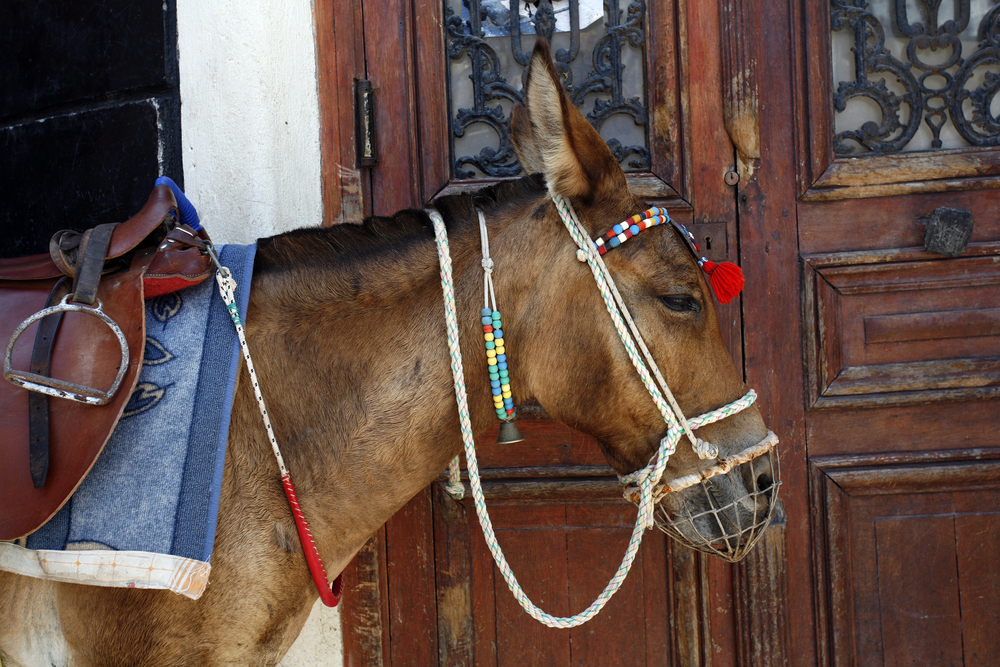
A donkey realized that its master was going to butcher it. As it was on its way somewhere, it broke its halter and headed out onto the road to run away. As it was passing near the garden, it saw their cat crying, wiping away its tears with a kerchief. It said, “Why are you crying? Come, let’s go abroad together.”
So the cat followed it. It went a little farther and they saw the dog howling. They said, “Comrade, why are you crying? Come, let’s go together.”
So the dog followed them. They went a little farther and found the rooster, which was crowing, and they said, “Comrade, why are you crowing? Come, you should also come along with us: we are going abroad.”
So he, too, followed them. They came to a forest where they were going to have to spend the night. They said to the cat, “Climb up into a tall tree and look to see whether there is a fire anywhere.”
The cat climbed into a tree and saw a fire in the forest, and they went over to it. Robbers were sitting around the fire and eating some meat. The animals came close to them and all began shouting and yelling. The robbers fled and the animals sat down and ate the meat.
The fire had been lit in an open hut. The cat went into the ashes, while the donkey went to stand inside the house, the dog just inside the door, and the rooster on a shelf. The robbers returned some time later and said to one another, “Go take a look to see whether any enchantment is still inside.”
Most of them were too afraid to go, but one went in. He could see the cat’s eyes gleaming. Thinking that they were some embers, he came close to try to reignite the fire. The cat scratched him badly and he fled. When he came into the house, he was kicked by the donkey, and as he fled past the door, the dog bit him. Then the rooster crowed. The robber ran outside and returned to his companions saying, “Eh, let’s go elsewhere. There is too much enchantment here. One thing scratched me all up, another beat me, and yet another bit me, but their king sat there and cried, “Kill him, kill!”
"The Two Sisters-in-Law"
Updated on Monday, May 10, 2010 9:02:04 am
Told by the Duality Narrator to D.K. Papadopoulos
One time there was an old man and an old woman who had two sons. The old man was a very hard-working person. He always found work, and he would work hard and earn their bread. The old woman, in her turn, was a very good housewife who ruled her house so adroitly that everyone was envious of her. One day, while the old woman was standing in good health, she suffered some sort of an attack and suddenly gave up the ghost. The unfortunate old man and his sons felt like orphans. They lived one or two years in that state, but they suffered badly having no one to look after them. The old man got tired of being without a housewife so he married off his older son to a girl from within their village. “It is a good family,” said the old man, “so she will look after us and we will not suffer.”
But he was wrong: his daughter-in-law was not the least good. She had laziness by the hundredweight, she was maliciously envious and very mean about helping out. And she had a mouth, God have mercy, if someone only stepped on her hem as a joke![1] The old man not only saw no good from his daughter-in-law, but he also had to listen to everyone else’s opinion of her, but didn’t dare correct her. He practiced patience for a fair amount of time and then he saw that this was no kind of a life, so he built a new house, furnished it, and told his older son to start a new establishment over there. And that’s what happened.
But the unfortunate old man was once again without a housewife. He married off his younger son to a bride from far off. She was totally unrecognized and unknown, but she turned out a very good little bride. She had all the virtues, modesty, industry, cleanliness, and she had such a good heart that she couldn’t bear to spoil the happiness even of an ant. She took good care of her father-in-law, looked after her husband, did all the chores of the house, and never said a word.[2] Her father-in-law swore by her head and he did anything she asked him to. . They led such a beautiful life that others were jealous of them![3] In the village, everyone was always talking about them and especially about the old man’s daughter-in-law. All the villagers loved “the little bride,” as they called her, and caressed her.[4][5] The only person who wanted nothing to do with her was her sister-in-law, who couldn’t stand her.
But the old man’s daughter-in-law was as unlucky as she was good and industrious. Her happiness did not last long. Her father-in-law died within a year and her husband became very sick. She took very good care of him and, in doing so, ended up spending more money than they had, but he never recovered. His illness was a serious one, and he died young, without fulfilling the promise of his youth. So the little bride was left a widow, deserted by everyone. There was no one even to tell her, “God created you.” Her brother-in-law had gone abroad to work and her sister-in-law had no eyes with which to see her.[6] She did not want to return to her parents’ house, because her father had died and her mother was very poor. So she remained in her father-in-law’s house and suffered savage hunger. Her sister-in-law had everything she needed, but she was a hard bitch’s daughter, who would give her nothing while looking her in the face. There was work in the springtime and the widow went into the fields. Everyone preferred her, as she was hard-working and honest. In that way she was able to make a living through the summer and put something aside more or less for the winter.
In the autumn there less outdoor work, but the little bride still found employment. She took in strangers’ wool to spin. But as the days grew shorter, she didn’t manage to do so much work. Everyone was sitting around at the night having evening work parties[7], but how could she herself have an evening work party? She didn’t have a lamp or kerosene. Once or twice she attended an evening work party in the neighborhood, but she couldn’t’ get enough work done that way. She was also too ashamed, after going to one, to go to another in the same place. For several days she didn’t go to any. She became behind in her work and didn’t know what to do about it.
One evening she took her work in hand and went to her sister-in-law’s evening work party. She didn’t want her there, but she didn’t say a word against it. They conversed about one thing and another and, when the little bride had gotten up to go home, her sister-in-law told her that she should always come to her evening work parties. So the poor woman took courage, and started bring her work to her parties. She spun very quickly. She could fill two spindles in the time it took her sister-in-law to do half a spindle-full. She had pressing jobs and was at some pains to finish them. She went two or three evenings to the evening work parties, but then for some reason her sister-in-law became angry and wouldn’t let her return.
She went to sit outside the house where she could spin in the light from the window. In that way she managed to get her work done for several evenings. But somehow her sister-in-law figured out what she was doing. She took the lamp away from the window and hung a black curtain across it so that no light could seep out. Since that path was now blocked, the poor little bride did not know what to do. When it grew darker and she could no longer see well enough to spin, she sat and wept at her luck. She was so beset by her troubles that she couldn’t sleep.
One evening she took her work and went outside to see if she could spin by starlight. She tried and tried, but in vain, because you can’t spin by starlight. While she was looking around, she saw a light in the far distance, in an upper part of the forest. Sometimes it was brighter and sometimes dimmer, but it didn’t go out. She said to herself, “Let me go see what that light is. I will have myself a little work party and then return home to lie down. This night feels as long as a year and I can’t sleep at all.”
She got on the road and went straight there. She found a great cave, in the middle of which a fire had been built. Twelve young men were sitting around the fire and warming themselves. She was afraid to get too close to them, but she also didn’t want to waste time. She sat down at the foot of a small cedar tree not far from the light and began spinning. Before long her hands became too stiff from the cold for her to work any longer. She wound up the thread she had made and got up to move closer to the fire. While she was walking she stepped on a dry little branch. The wood snapped loudly and she cringed in fear and stood frozen to the spot. The young men heard the snapping sound and turned and saw her. They said, “Come, good woman, come get warm, come, don’t be afraid.”
The little bride took courage, shook the earth off herself, and went into the cave. They made a place for her near the fire and she sat down. She looked around at the young men in amazement. All of them were as beautiful as angels and you would have said that one mother had born them all. They looked so much alike that you could tell one from the other, and they were all wearing the same thing. The young men asked, “How do you come to be up here in this way at the wrong time? What trouble do you have?”
The little bride said, “My troubles are many, but let me stay here near the light and spin this wool, as it is for other people and I am in a hurry to finish it and return it to them. But while I am working, I will tell you my troubles.”
They said, “All right, if that would be easier for you, do it that way.”
She took her spindle in her hand and began spinning. She was working very quickly. In one instant she had spun a spindleful of thread, rolled it into a ball, and begun the next. At the end of every ball, the young men got up in turn to put wood on the fire. While the bride was spinning the wool, her troubles came into her head. She remembered her good father-in-law, her husband, and the behavior of her sister-in-law, and grief took hold of her. She began keening something between a song and a lament, consider it what you like. She sang of her troubles. She told the story of everything she had suffered: how she once lived at her parents’ house, how she had married, and how she had been widowed. When she told about her unfortunate husband, she was already crying. She mentioned the month in which he had taken sick and month and day on which he had died, and in the end when she had finished spinning her wool, she also sang this lament: “The months are all good, but my husband did not have years to live,
“And the days are all good, but I have no luck.”
Her work was done. The widow wiped away her tears, tied the twelve balls of wool that she had made one to the other so that they not fall and get lost, took her spindle and prepared to leave. The twelve young men were the twelve months. They were pleased with the widow’s good words and wanted to help her. They each took a handful of burning embers and put them in the little bride’s apron and said, “Be careful not to open your apron before you get home. Once you get there, pour them down the chimney of your house and open the door in the morning.”[8]
The widow took her balls of wool and her spindle, thanked them, and left. She clutched her apron tightly and as she was running along she thought, “What were those young men? How is it that they didn’t burn their hands when they picked up those burning embers?” That’s what she thought these things as she was going along.
She arrived at her house and did what the young men had told her to. In the morning when she awoke, she ran to open the door of the inside of the house[9]and saw that all the embers that she had poured down the chimney had become gold coins. She heaped them up, stored them in her linen-chest, and was overjoyed. She bought what she needed to provisionher house well. She also bought a good lamp and some kerosene. She lit it in the evenings and held working parties as often as she wanted to. In this way she was able to do her work and make a good living. No one else knew how this miracle had come about.
Her sister-in-law, as we have said, lived well at one time. But she was very untidy and spent far too much in order to show off to everyone. But this didn’t last very long. No one knew what her husband was doing abroad. He never inquired about her and sent her nothing. Her goods and property ran out. She was reduced to one mouthful of dry bread a day and sometimes not even that, because she was lazy and had no eye for work. She saw that her sister-in-law the widow had things and was managing to live well, and her ill will knew no bounds. She didn’t want to see her, but desperation sent her to her. She asked her how she had managed to get her work done and live as well as she did. The widow had a good heart, without an ounce of cleverness or devilry. She told her everthing that she had seen and done. She hid nothing from her.
So the next day, after dark had fallen, the old man’s older daughter-in-law took a hank of wool and her spindle and went to the cave where the twelve young men were. They were there sitting all around the fire and warming themselves. She burst into the cave noisily, sat herself down without being asked, and began to spin. She spunthe wool into very thick thread and wound it onto her spindle. Without being asked, she began to tell of her troubles. She didn’t pa attention to what she was saying. She got things all muddled up. She blamed her father-in-law, her neighbors, her sister-in-law, and just as her wool was running out she blamed her husband, the day she met him and the day and month when he disappeared to work abroad. In the end she sang this lament: “I don’t love the end of March, and that of April I want not at all!” The end of March was when she had gotten married, and the end of April was when her husband had gone abroad.
When she had sung her lament, she picked up her balls of wool and prepared to leave. The young men each took a handful of burning embers and put them in her apron and told her the same thing they had told her widowed sister-in-law. She left without thanking them and quickly returned to her house. She poured the embers down the chimney into her house and went to lie down. But how could she sleep? All night long she saw liras and florins dancing in her head. Very early the next morning she ran and joyfull opened the door of the house. She found the inside filled with snakes, which immediately fell on her and ate her up. After that the widow lived even better.
[1]Check translation.
[2]Mention mash’.
[3]This kind of situation would be seen as provoking the evil eye, whether intentionally or not.
[4]Check nuance of translation of this word.
[5]They may adore her now, but later in her time of need no one seems available to help. Is that because of her pride, or because of the social structure of the village? Certainly it fits the need of the story.
[6]I.e., she didn’t want her.
[7]Find a translation for this. Clearly an event that rotated among houses. Also need to discuss what a parakad is: it shows up in a number of folktales and is often where folktales that reveal a persecuted hero/ine’s true identity are told.
[8]How is this injunction significant?
[9]Need to find out typical constructions of Pontic houses. This sounds odd.
"What Your Heart Desires Is What is Beautiful"
Updated on Wednesday, April 14, 2010 9:07:35 am
Told by Myr. Amoiridou to Efstathios Athanasiades
Once three people from a village went abroad. They stayed away for one year. Two of them managed to earn some money and returned to their homes in the autumn. The third one didn’t succeed in earning anything, so he stayed abroad. After Easter the other two returned to the same place and found him. They again found work and again the other two managed to earn something and returned home again at Christmas. Again, the third one didn’t manage to earn enough, so he stayed behind. The other two returned again in the spring and found him, and again the worked and earned money, while he still did not.
That fall, when they got ready to return to their houses, the two said to their companion, “It looks as though this year you have still not been able to put any money aside. Listen to us: let’s return together to the homeland. Perhaps your gouri will also be returned. We will give you one and half gold coins and we will also take care of your travel expenses.”
“I will do as you suggest,” he said, and they set out together.
When night fell they were near a city. They said, “Let’s spend the night here, and tomorrow before dawn we can set out on the road again.”
They went to buy bread from the bakery and asked the baker if he would let them sleep over the oven. They learned from the baker that at the edge of the city was a man who was very learned and wise, and who gave advice. The poor man decided to go ask the wise man’s advice. The next day as the others were setting out, he remained behind. He kept asking around until he found the wise man. He said, “I want you to give me a piece of advice.”
“A piece of advice costs half a gold coin.”
“All right,” said the poor man.
“Whatever your soul and your heart love is beautiful,” said the wise man.
“Even my kalomanna could have told me that,” the poor man said to himself, but he handed over half a gold coin. “Let me have another piece of advice.”
“Each person must pass through an unavoidable danger,” said the wise man.
“As if I didn’t know that! What a waste of money,” thought the poor man was thinking as he handed over another half lira. “You might as well give me another piece of advice so that my wallet is totally empty.”
“Never leave the evening’s work until morning,” the wise man said.
“Nothing came of that,” the poor man said to himself as he handed over his last half lira, so that his walled was empty and ringing(?)tinagmenon. He set back out on the road and started thinking about what he should do. His companions had given him a lira and a half, but he had wasted them. What road should he take? Should he throw himself into an abyss and kill himself? Should he throw himself into the sea and drown?
As he was thinking and walking along he came across a caravan. The drovers had unloaded the horses so that they could drink and eat and rest, but the well where they had always found water before had dried up. Every time they let the pitcher/skevosdown, it came up empty. As they were wondering what to do, the poor man showed up. He said, “I will go down there to see why the pitcher keeps coming back empty.”
They tied a rope around him and very slowly lowered him down. He had not set foot down there before he found an Arab sitting to one side with two girls in front of him. The one girl was perfectly beautiful: she shone, she dazzled the eyes. The other was as dark as the Arab and very ugly: if you had come across her in the night, you would have been scared and ‘s sa seranta ‘k’ errouznes. The Arab asked him, “What are you searching for down here?”
The poor man said, “I came down to see why the spring has dried up.”
The Arab asked, “Which of these two girls is the more beautiful?”
The poor man remembered the wise man’s advice and said, “Whatever your soul and your heart love is beautiful.”
“Well said!,” said the Arab. “You can go back up now. I will give the water back.”
The poor man tugged on the rope and so that alogant they pulled him up. He hadn’t set foot on the ground before the water filled the well. They rejoiced alogant, since their way always took them past it. They opened a sack saying, “Use your hands to scoop out as much of this money as you can.”
The poor man filled his cupped hands with the money and returned joyfully to his little house.
"The Fox That Changed Color"
Updated on Monday, October 25, 2010 10:23:04 am
Told to Savvas Ioannides
A fox once found herself in a city. When the children caught sight of her, they began chasing her. As she was running here and there, she jumped into a painter's barrel which was full of paint and ended up entirely changing her color.
When the lions saw her looking like that, they were frightened; the other animals also saw her and fled. When another fox realized who she was, he believed that if she became king, she would favor her sister foxes, since the other animals were so frightened by her. She mentioned this to the other foxes and they were in agreement, so they made her their king. One day, however, when there was a war on and everyone could she her having difficulties, they suddenly saw her rise to her feet. Until that moment the fox had been honored because of the color of her coat, but now she learned the color did not bring honor to the person but that the person had to bring honor to his color.
"The Priest, the Bear and the Fox"
Updated on Monday, May 3, 2010 2:32:55 pm
Told to Xenofon Akoglous
Once when a priest was going out to the field, he saw a she-bear playing with the male jackals and foxes, and he laughed and continued to his field. As he was returning, the bear came up to him and asked, “Priest, why were you laughing? No, I know why. You were laughing because I was playing with the male jackals and foxes. I beg you very much, mention this to no one. If you don’t, every evening I will bring you the skin of an animal. But if you do tell anyone, priest, you may be sure that I will come eat you.”
The priest gave her his word and did not tell anyone. Thus the bear started leaving an animal skin on his chimney every evening. The priest’s wife suspected that something was up and asked him, “What is going on, priest? You know what it is and no matter what you will tell me about it.”
The priest refused. He didn’t want to say anything, since he was afraid that, if he did, the she-bear would eat him. But the priest’s wife put her foot down and insisted on learning what was going on. “he finally told him, “Tell me or I will poison myself!”
The priest saw that he was caught between a rock and a hard place[1], “I’ll tell and then let’s be done, the chips fall where they may.”
So he told her the story,[2]what had happened and what was going on. But the bear efokrountoun[3] and heard him. SOMETHING MISSING?
The next day, as the priest, lost in thought, was going to the field, a fox came up to him and said, “Priest, you seem a bit worried. What’s wrong that you are lost in thought?”
The priest said, “You can’t cure of my sorrow, so why should I tell you?”
The fox said, “Tell me, priest, what do you have to lose? I will make the earth a source[4]and I will find the solution to your sorrow.”
The priest then explained the situation.
“What could be easier?” said the fox. “I will save you, but you have to do what I tell you to. You must also agree that, if I do save you, you will give me your right testicle to eat.”
“All right,” said the priest, and continued on to his field. When turned around, the bear had come to stand in his way. She said, “Hey, priest, you told my secret. I am now going to eat you up.”
The priest looked all around him, but the fox was nowhere in sight, so he begged, “Since you are going to eat me up no matter what happens, let me finish my work in the field, as I will leave my babies as orphans, when you eat me.”
“All right,” said the bear and sat down to wait for him. A little while later, the fox appeared at a distance and called, “Heeey, priest, have you seen a bear anywhere around here?”
The bear said to the priest, “Ask him what he wants with a bear?”
The priest shouted[5], “What do you want with a bear?”
The fox said, “The king has fallen ill and wants a bearskin.”
The bear said, “Tell him there is no bear here.”
The priest said, “There is no bear here.”
The fox asked, “But what is that I see over there?”
The bear said, “Tell him it is boiled wheat[6].”
The priest said, “It is boiled wheat.”
The fox said, “Put it in the bag.”
The bear said to the priest, “Put me in the bag quickly!”
The priest put her in the bag and the fox called, “Tie the sack tightly.”
The priest twisted the end of the bag and tied it tightly. The fox said, “Use the axe!”[7]
The priest kept hitting until he had killed the bear. Then the fox whistled[8]and approached the priest saying, “Priest, did you see how I saved you? Now you must let me eat your right testicle as we agreed.”
As the priest was taking the belt out of his trousers[9], his stomach rumbled[10]. “Priest, what made your stomach rumble?” the fox asked.
The priest said, “A few days ago, I ate some little puppies. They have now grown up and want to get out.”
“Alas! Priest, please, buckle your belt back up! I’ll leave right this minute-- then you can take them out,” said the fox and was gone like the wind.
So the priest surpassed even the fox in his wiliness, and also saved his testicle.
[1]Lit., there was a deep before and an abyss behind him.
[2]Meselén; is this different from mesél – folktale?
[3]Translation!
[4]Check translation: ti gin pigin.
[5]Check translation: espihten k’ etjaixen.
[6]Kokkia (kollyva) Offered at memorial services.
[7]Check translaton: kiouskin = axinari.
[8]Check translation.
[9]Check translation.
[10]Check translation.
- "You Only Eat If You Work"
- "The Three Princes"
- "The Crazy Man and the Clever Man"
- "The Frog Bride"
- "The Two Drunk Men"
- "The Donkey and His Friends"
- "The Two Sisters-in-Law"
- "What Your Heart Desires Is What is Beautiful"
- "The Fox That Changed Color"
- "The Priest, the Bear and the Fox"